
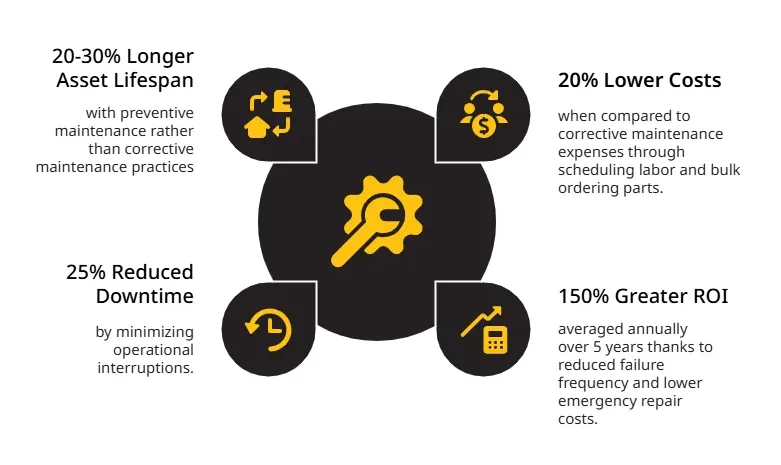
Preventive maintenance is a structured maintenance strategy focused on preventing equipment failure before it occurs. Instead of reacting to breakdowns after damage becomes severe, preventive maintenance uses scheduled inspections, servicing, lubrication, testing, and repairs to maintain equipment in optimal operating condition.
Think of industrial equipment like the human body. Waiting until a major medical emergency happens before seeing a doctor usually leads to higher costs and more serious consequences. Regular health checkups help identify small problems early, reducing the risk of catastrophic failure later. Preventive maintenance works in exactly the same way for industrial systems.
Traditional reactive maintenance strategies may seem cost-effective in the short term because businesses spend less money upfront. However, unexpected failures often create chain reactions across production systems. A failed pump can halt an entire manufacturing line. A corroded pipeline can trigger environmental cleanup costs. A damaged electrical component can shut down critical operations for days.
Modern preventive maintenance programs are far more advanced than simple routine inspections. In 2026, industries increasingly combine digital sensors, AI-powered analytics, drone inspections, and predictive maintenance software to monitor equipment conditions continuously. This allows engineers to identify wear patterns, corrosion activity, vibration anomalies, and thermal irregularities long before failure occurs.
Preventive maintenance also improves operational planning. Instead of emergency shutdowns disrupting production unexpectedly, maintenance teams can schedule repairs during planned downtime windows. This dramatically reduces operational disruption and improves productivity across industrial facilities.
Common Causes of Equipment Failure
Mechanical Wear and Fatigue
Industrial equipment operates under enormous mechanical stress every day. Rotating machinery, pumps, compressors, turbines, conveyors, valves, and structural systems constantly experience friction, vibration, pressure fluctuations, and repetitive loading cycles. Over time, these forces gradually weaken components through wear and fatigue.
Mechanical fatigue often develops silently. Bearings begin losing efficiency, seals deteriorate, lubrication systems become contaminated, and structural components slowly weaken under repeated stress. Without regular inspections and maintenance, these small problems can eventually trigger catastrophic equipment failure.
Temperature fluctuations also accelerate material degradation. Industrial systems exposed to repeated heating and cooling cycles experience thermal expansion and contraction that can weaken welds, crack coatings, and damage mechanical joints. Preventive maintenance programs help detect these early warning signs before they compromise system integrity.
In many industries, operators unknowingly continue running equipment under suboptimal conditions because damage is not immediately visible. Misalignment, vibration imbalance, and lubrication breakdown can slowly reduce efficiency while increasing energy consumption and wear rates.
Corrosion and Environmental Damage
Corrosion remains one of the most destructive and expensive causes of industrial equipment failure worldwide. Metal structures exposed to moisture, salt, chemicals, humidity, and industrial pollutants gradually deteriorate through electrochemical reactions.
The challenge with corrosion is that it often progresses invisibly beneath coatings, insulation systems, or enclosed structures. Corrosion under insulation (CUI), pitting corrosion, galvanic corrosion, and stress corrosion cracking can weaken critical infrastructure long before visible damage appears.
Marine environments are especially aggressive because airborne chlorides accelerate oxidation on exposed metal surfaces. Chemical plants and refineries face additional risks from acidic vapors and corrosive process materials.
Without preventive conservation measures, corrosion can shorten equipment lifespan dramatically. Pipelines, storage tanks, offshore structures, heat exchangers, and steel frameworks all become vulnerable to structural degradation and safety failures.
How Corrosion Impacts Operational Costs
Hidden Financial Risks
Corrosion creates far more financial damage than many businesses initially realize. The direct costs of replacing corroded equipment are only one part of the problem. The larger financial impact often comes from production interruptions, emergency repairs, labor costs, environmental penalties, and reduced operational efficiency.
A small corroded valve may seem insignificant at first, but if it causes an unplanned shutdown in a major processing facility, the resulting downtime can cost thousands or even millions of dollars per day. Industries such as oil and gas, power generation, and chemical processing are especially vulnerable because their operations rely on continuous production.
Corrosion also increases energy consumption. Roughened pipe surfaces reduce flow efficiency, damaged heat exchangers lose thermal performance, and deteriorating mechanical systems require more power to maintain output. Over time, these inefficiencies create substantial operational losses.
Another hidden expense involves accelerated infrastructure replacement. Facilities relying on reactive maintenance often replace assets years earlier than necessary because corrosion damage becomes too severe to repair economically.
Safety and Environmental Consequences
The safety risks associated with corrosion can be even more expensive than the physical repairs themselves. Corroded pressure vessels, pipelines, and structural systems increase the likelihood of leaks, fires, collapses, and hazardous material releases.
Environmental incidents caused by equipment failure may trigger cleanup costs, regulatory fines, legal liabilities, and reputational damage. In highly regulated industries, a single corrosion-related accident can affect business operations for years.
Preventive maintenance reduces these risks by identifying vulnerable areas before failures occur. Early intervention protects both operational continuity and worker safety.
Benefits of Scheduled Maintenance Programs
Increased Equipment Reliability
One of the biggest advantages of preventive maintenance is improved equipment reliability. Facilities that maintain consistent inspection schedules experience fewer unexpected breakdowns and more stable production performance.
Reliable equipment allows companies to plan operations more effectively, meet production targets consistently, and reduce customer delivery delays. This operational stability becomes a major competitive advantage in industries where downtime directly affects profitability.
Preventive maintenance also improves equipment efficiency. Proper lubrication, alignment adjustments, corrosion protection, and calibration help machinery operate closer to optimal performance levels.
Lower Emergency Repair Costs
Emergency repairs are almost always more expensive than planned maintenance activities. When equipment fails unexpectedly, companies often face urgent labor costs, expedited parts shipping, overtime payments, and production losses simultaneously.
Scheduled maintenance allows businesses to purchase materials strategically, allocate labor efficiently, and avoid premium emergency expenses. Maintenance teams can also repair multiple systems during planned shutdowns instead of responding to isolated failures individually.
This planned approach reduces overall maintenance spending while improving operational predictability.
Reducing Downtime Through Early Detection
Predictive Monitoring Technologies
Modern industrial facilities increasingly use predictive monitoring systems to detect problems early. Smart sensors track vibration, temperature, humidity, pressure, corrosion activity, and equipment performance continuously.
AI-powered analytics platforms analyze this data to identify abnormal trends that may indicate developing failures. Instead of relying solely on calendar-based inspections, engineers can prioritize maintenance activities based on actual equipment condition.
This data-driven approach improves maintenance efficiency and reduces unnecessary servicing while still preventing failures before they occur.
Real-Time Asset Inspections
Drone inspections, robotic crawlers, thermal imaging cameras, and ultrasonic testing technologies are transforming industrial inspections in 2026. These tools allow maintenance teams to inspect hard-to-reach areas safely and accurately without shutting down operations.
Real-time inspections also improve corrosion management by detecting hidden deterioration earlier than traditional visual methods.
The result is reduced downtime, improved worker safety, and faster maintenance decision-making.
Long-Term ROI of Industrial Conservation
Extending Asset Lifespan
Preventive maintenance dramatically extends the operational lifespan of industrial assets. Coatings, lubrication systems, cathodic protection, routine inspections, and scheduled repairs all slow down equipment degradation.
Instead of replacing infrastructure prematurely, companies can maximize the value of existing assets over much longer operational periods.
Lifecycle Cost Reduction
Many businesses focus too heavily on short-term maintenance costs while ignoring total lifecycle expenses. Preventive maintenance reduces long-term costs by minimizing breakdown frequency, lowering repair severity, and improving operational efficiency.
The return on investment becomes especially significant in large industrial facilities where infrastructure replacement costs are extremely high.
Well-maintained assets also retain higher resale value and require fewer major overhauls over time.
Best Maintenance Practices for Industrial Assets
Inspection Planning
Effective maintenance programs begin with structured inspection planning. High-risk equipment should receive more frequent monitoring based on operational conditions, environmental exposure, and historical failure patterns.
Digital asset management systems now help companies track maintenance schedules, inspection results, and performance trends more efficiently.
Corrosion Prevention Strategies
Corrosion prevention remains one of the most important aspects of industrial conservation. Best practices include:
- Applying high-performance protective coatings
- Using corrosion-resistant materials
- Conducting regular surface inspections
- Monitoring humidity and environmental conditions
- Implementing cathodic protection systems
- Replacing damaged insulation promptly
Facilities that combine preventive maintenance with strong corrosion management programs achieve the best long-term operational performance.
Conclusion
Preventive maintenance has become one of the most valuable operational strategies in modern industry. Instead of waiting for equipment failures to disrupt production and increase expenses, businesses are increasingly adopting proactive maintenance models focused on early detection, asset preservation, and long-term efficiency.
By reducing corrosion damage, minimizing downtime, extending equipment lifespan, and improving reliability, preventive maintenance delivers measurable financial benefits across virtually every industrial sector.
The industries that succeed in 2026 will not be the ones that repair equipment fastest after failure occurs. They will be the ones that prevent those failures from happening in the first place.
